Last updated: November 18, 2026
The Clearance Bit That Makes All the Winter Riding Possible
I’ll never forget the first time I rode into China on my old BMW R1200GS, back in 2019, snow dusting the Laos-side hills as I pulled up to the 磨憨 border post. I’d spent weeks panicking about winter riding conditions, but the thing that actually made the whole trip work wasn’t my heated grips or my studded tyres — it was getting the entry paperwork sorted properly before I even left home.
Here’s the blunt truth I learned the hard way: you can’t just turn up at a Chinese border with your bike and clear customs on your own. Foreign vehicle entry into China has to be declared through a qualified travel agency that acts as your guarantor. That agency needs a RMB 1.6 million tourism quality deposit and three years of operation under their belt to be allowed to do this work — it’s not a casual side hustle, and cutting corners here will leave you stuck on the wrong side of the border in sub-zero temperatures.
For most riders coming from Southeast Asia, 磨憨 is the logical entry point. The service fee for foreign motorcycle temporary entry China at 磨憨 runs 5,000-6,000 RMB for most bikes, dropping to 4,000 RMB if your bike is registered in Laos. That fee covers everything you actually need to get moving: customs declaration, immigration formalities, your Temporary China Licence, your motorcycle temporary plate China, exit clearance later on, route filing, and on-site help at the port. What it doesn’t cover is the RMB 10,000 customs deposit you’ll pay — fully refunded within 3-5 working days after you exit, as long as you don’t overstay, have no unpaid fines, and wrap up all customs matters properly. That deposit goes into a corporate account, never a personal one; if anyone asks you to send it to an individual’s WeChat or bank account, walk away.
China doesn’t recognise the International Driving Permit, so your home licence plus that Temporary China Licence the agency arranges is what you’ll carry. The motorcycle temporary plate China is valid for three months — no renewals, no extensions, so plan your winter route to fit that window. Compulsory traffic insurance is mandatory before you get that plate; the agency arranges it before entry and you pay the actual cost. I learned that the hard way when I tried to skip it on a 2022 run and sat in the port office for two hours waiting for cover to be sorted while the temperature dropped to -2C.
You’ve got four land ports to choose from: 磨憨 (China-Laos), 霍尔果斯 (China-Kazakhstan), 吉隆 (China-Nepal), and 二连浩特 (China-Mongolia). Left- and right-hand-drive bikes are accepted at all of them, same fees, no surcharge. I ride a UK-registered right-hand-drive Triumph Tiger these days, and I’ll warn you — take a day to adjust to riding on the right before you hit fast winter roads. I misjudged an overtake on the G318 in 2023 because I kept drifting left, and nearly clipped a snow plough. Embarrassing, cold, and a reminder that right-hand-drive takes getting used to.
Riding Through Snow and Fog: What I Wish I’d Known Before My First Winter Run
Last January, I was riding the G109 out of Golmud, heading west towards the Qinghai-Tibet highway, when the fog rolled in so thick I could barely see the front wheel of my bike. It wasn’t the pretty, soft valley fog you get in the Lake District — this was the sharp, biting kind that sticks to your visor, freezes at the edges, and makes road signs vanish 20 metres ahead of you. I’d stupidly set off that morning without checking local weather reports, assuming the clear sunrise meant clear roads.
Here’s what I do now, after three winter China motorcycle road trips:
- Always pack a spare, clear visor with an anti-fog coating. My tinted visor froze solid that day outside Golmud, and I had to ride 12 kilometres with my visor cracked open, my eyelashes icing over, until I reached a truck stop.
- Don’t ride at dusk if you can avoid it. Winter fog on the high plateau tends to settle hard between 4pm and 6pm, and the light gets that flat, grey glare that makes it impossible to tell where the tarmac ends and the snow verge starts. I once missed a turn onto the G214 because of this, and ended up on a side road covered in unploughed snow — not a fun place to drop a 230kg bike.
- Stick to your filed route. The agency sorts out your route filing as part of the service, and you can’t just veer off into restricted border areas. Some parts of Xinjiang and Gansu are off limits to foreigners, the G219 at the Dahongliutan section and the Kashgar/Yecheng to Ritu (Pangong Lake) stretch are closed, and the new Minfeng no-man’s-land highway is no-go. If you want to go to Tibet, you’ll need a full-time guide and a Tibet permit — your Temporary China Licence works nationwide, but you can’t ride solo in Tibet. If you’re coming from Xinjiang, you have to detour via Golmud on G109 to get to Tibet; the direct route is closed to foreigners.
- Checkpoint stops are normal. If a police officer waves you down, the agency can provide supporting documents remotely — you don’t need to carry every single paper copy, but keep your passport, temporary licence, and plate paperwork in a waterproof pouch on your bike. I once had my paperwork soaked through by melting slush, and spent 40 minutes at a checkpoint explaining myself while my gloves froze stiff.
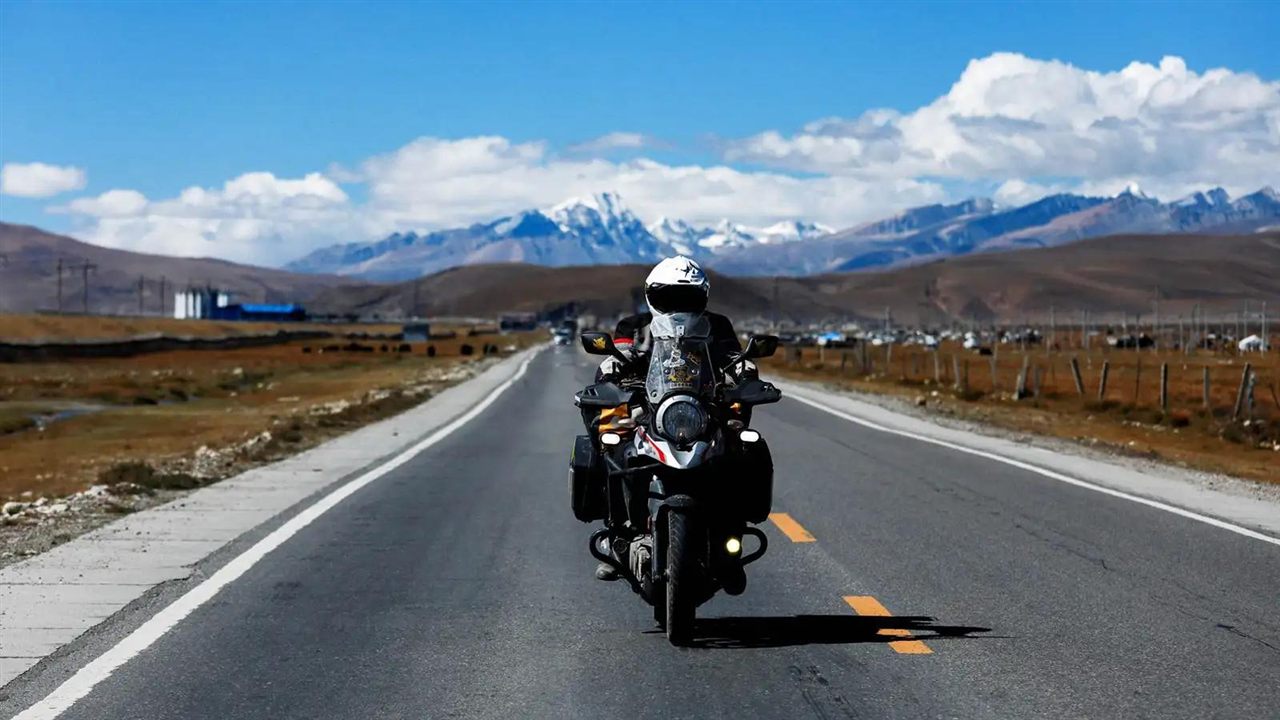
People ask me all the time if winter is worth it. The summer rides are busy, full of other tourists, but the winter roads? You’ll have whole stretches of the G318 to yourself, the snow-capped peaks of the Hengduan mountains glowing pink at sunrise, and the kind of quiet you don’t get on a UK motorway. But you have to respect the conditions. I dropped my bike once on an icy patch outside Kangding, because I was going 10km/h too fast. No damage, just a bruised ego and cold hands, but it reminded me that even on a well-prepared China motorcycle road trip, the weather doesn’t care how much paperwork you have sorted.
Pro tip: Ports don’t stay open 24 hours. If you’re riding in winter, aim to arrive at your exit port by mid-afternoon. I once got caught in a blizzard on the way to 磨憨, arriving 20 minutes after the port closed, and had to spend the night in a small guesthouse on the Laos side. Cold noodles, no hot shower, and a very grumpy me the next morning. Don’t make that mistake.
Plan your timing right, get your motorcycle customs declaration China sorted through a qualified agency, pack extra warm layers, and keep your speed down when the visibility drops. The winter rides in China are some of the best I’ve ever done — but they’re not for riders who cut corners on prep.