Last updated: November 18, 2026
What the Tarmac Actually Feels Like, When the Ice Thaws
I pulled into a roadside pull-off outside Kunming last April, knee-deep in the smell of damp pine and freshly cut rapeseed, and wiped a layer of fine red Yunnan dust off my visor. That’s the first thing most riders don’t prepare for: non-winter riding in China isn’t the smooth, empty autobahn-style cruise you might picture. It’s patchwork tarmac, sudden shade that drops the temperature by 8 degrees when you dip into a gorge, and the kind of glare off wet concrete that makes you fumble for your polarized lenses halfway up a climb.
Most people planning a China motorcycle road trip fixate on border formalities first, and that’s fair — but the riding itself, once you clear customs, is its own learning curve. No frozen mud, no black ice slicks across high passes, but plenty of other surprises if you’ve only ever ridden European or Southeast Asian roads.
First, the bit no one skips: getting your bike through the border
I rode in through 磨憨 (Mohan) three years ago, on a 2017 Honda CRF 1000L with Laotian plates, right-hand drive. I’d spent weeks reading forum posts about how to self-clear, convinced I could save a bit of money by showing up with my paperwork and negotiating at the booth. That was a stupid mistake. An individual rider has no standing to declare a vehicle for entry — you cannot do this on your own. Every foreign vehicle, motorcycle included, has to be declared through a qualified travel agency acting as your guarantor. Those agencies hold a RMB 1.6 million tourism quality deposit and three years of operational experience, per Chinese customs rules.
That Mohan border motorcycle customs clearance process took me four hours, not because the agents were slow, but because I’d shown up without realizing the service fee for Laos-registered bikes at Mohan sits at RMB 4,000, part of the standard package that covers customs declaration, immigration checks, your temporary driving licence, temporary plate, exit clearance later, route filing, and on-site port help. For non-Laos bikes entering at Mohan, that fee lands between RMB 5,000 and 6,000. It’s a flat rate, too — no per-day charges, whether you stay one month or three.
You’ll pay a RMB 10,000 customs deposit on top of that, paid directly into the agency’s corporate account — never a personal WeChat or bank transfer, no exceptions. It has to land three full days before you arrive, otherwise the declaration gets cancelled and the service fee isn’t refunded. I cut it close, paid it two and a half days out, and spent a very anxious 48 hours refreshing my bank app until the agent confirmed it had landed. Don’t be me. That deposit comes back to you, fully, 3-5 working days after you exit via the same route — as long as you don’t overstay, have no unpaid traffic fines, and no unfinished customs business hanging over you.
“I stood there watching the agent stamp my Temporary China Licence and my motorcycle temporary plate China paperwork, and realized all the forum horror stories about being turned away at the border were just riders who tried to cut the agency step out.”
China doesn’t recognize the International Driving Permit, so that temporary licence arranged by the agency is the only legal document you’ll hold while riding here. The temporary plate is valid for three months, full stop. You can get a longer tourist visa via an agency invitation letter if you want to stay longer, but don’t show up expecting to extend the plate itself — that’s not how it works. Compulsory traffic insurance is mandatory before that plate gets issued; the agency sorts that out before you enter, and you just cover the actual cost. Optional commercial third-party cover starting at RMB 500,000 is worth adding, in my book — I rode without it once on a shorter trip, and spent every overtaking manoeuvre stressing about what would happen if I tapped a local truck’s bumper.
What the non-winter roads actually ride like
Once you’re rolling, the first adjustment is the side of the road. China drives on the right. I run a right-hand-drive bike, and the first hour out of Mohan I kept drifting left toward the kerb, misjudging the width of oncoming lorries because my muscle memory was still set to UK roads. Give yourself that first hour, no rush. Pull over, walk around the bike, reset.
Non-winter means no packed snow, no ruts frozen solid across mountain passes, but it does mean monsoon season in the south from June to August. I got caught in a torrential downpour outside Dali last May, where the tarmac turned so shiny it reflected the sky like a mirror, and drainage grates across the road were slick enough to make me wobble at 40km/h. The road surfaces themselves are generally excellent on the main highways — smooth, well-marked, with wide hard shoulders — but the smaller provincial roads through Yunnan and Sichuan have patchwork repairs, loose gravel at blind corners, and the occasional farm truck pulling out without indicating.
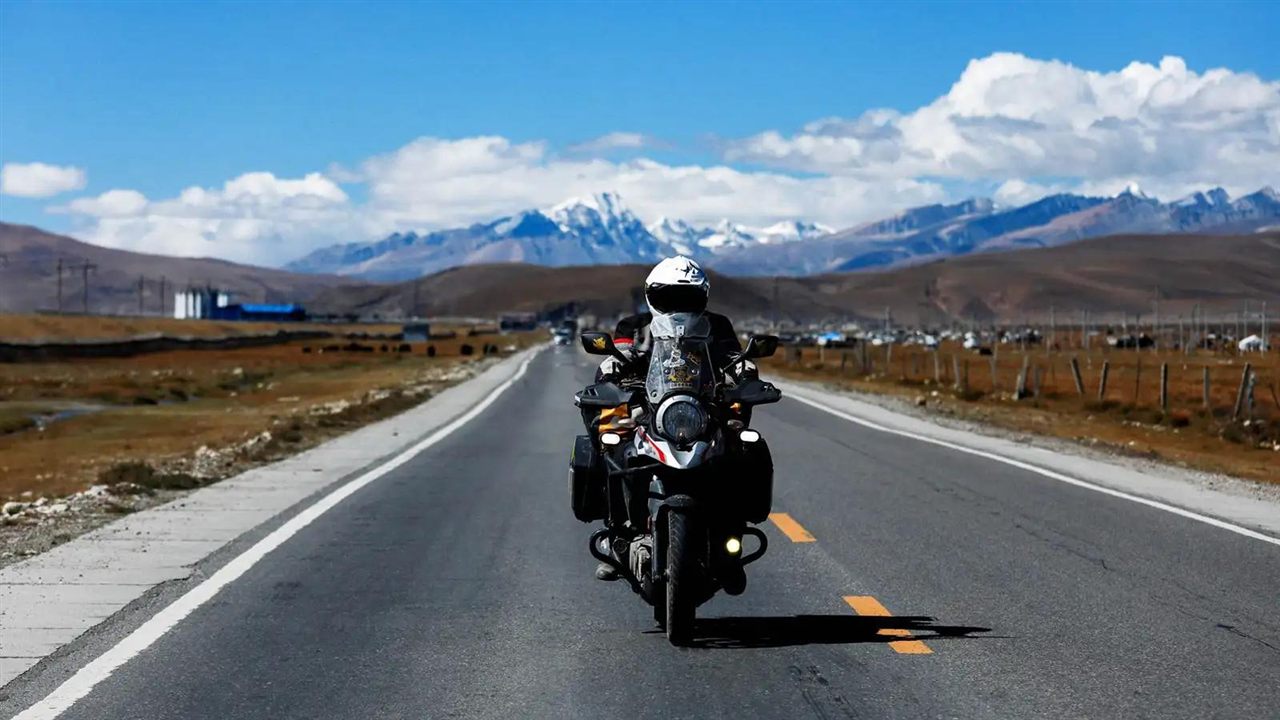
You can ride almost anywhere nationwide, but there are hard limits. Tibet requires a full-time guide and a Tibet permit, no exceptions. Beijing needs a capital entry permit. Some border-restricted areas in Xinjiang and Gansu are off limits. The G219 section at Dahongliutan, the Kashgar/Yecheng to Ritu stretch near Pangong Lake, and the new Minfeng no-man’s-land highway are closed to foreign riders. If you’re heading from Xinjiang to Tibet, you have to detour via Golmud on G109 — the legal highways into Tibet are G109, G318, and G214. I tried to plan a direct Xinjiang-Tibet run once, and spent three weeks rearranging my route to loop through Golmud instead. It added 600km, but it meant I didn’t get turned around at a military checkpoint 300km from my planned campsite.
The small, unwritten bits of riding here
Checkpoints will pop up. Police stops, ID checks, route verification. You don’t need a lead vehicle or an escort outside of Tibet — the agency provides supporting documents remotely when you pull over, so you don’t have to fumble through a folder of paperwork in Mandarin on the side of the road. Ports aren’t 24 hours, so don’t roll up at 10pm expecting to clear in. I’ve seen riders turn up at Mohan at 9.30pm, only to be told the booths closed an hour earlier, stuck sleeping on the sidewalk until morning.
Document prep matters. Get your passport, Chinese visa, home driving licence, white-background ID photo, vehicle licence, registration certificate, engine number, and front/rear/side photos of the bike sorted 20 days before entry — for Tibet itineraries, give it a full month. If your bike is over six years old, you’ll need an inspection certificate, and you’ll have to pass a vehicle inspection at the vehicle management office after entry (that costs about RMB 200). Some ports also ask for a valid home-country annual inspection certificate. The agency arranges Chinese translation for all your non-Chinese documents, so you don’t have to track down a certified translator yourself.
That foreign motorcycle temporary entry China process isn’t the nightmare it’s made out to be online, as long as you don’t try to skip the guarantor step. The riding itself, once you’re moving, is some of the most varied tarmac you’ll ever cover — from lush, humid karst peaks in the south to the wide, open, wind-scoured plains of the north. Just pack extra earplugs for the lorry noise, and don’t underestimate how long it takes to adapt to right-side riding after months on left-hand-drive roads.