Last updated: November 16, 2026
I’ve lost count of how many riders I’ve watched roll up to a Xinjiang checkpoint, sun-blistered and grinning, only to be turned away because their paperwork didn’t match the route they’d filed. Last September, I was one of them, perched on a Belgian-registered right-hand-drive BMW R1250GS, fresh off the 磨憨 border crossing, 200km outside Kashgar, when a uniformed officer tapped my temporary plate and pointed at a map. I’d assumed the open Pamir roads were all fair game once I had my Temporary China Licence in my pocket. I was wrong.
If you’re planning a China motorcycle road trip that takes you up into the thin air of the Pamir Plateau, the work doesn’t end when you clip your motorcycle temporary plate China to your rear rack. There are checks you need to run before you even roll up to the border, because fixing them once you’re on the road is next to impossible.
Why your temporary plate isn’t the finish line
Let’s get one thing straight first: motorcycle entry into China is not a do-it-yourself job. You cannot rock up to a border post with your bike and clear customs on your own. The rules are non-negotiable here: a foreign vehicle must be declared through a qualified travel agency acting as guarantor, and that agency has to hold a RMB 1.6 million tourism quality deposit plus three years of operation. That’s not a suggestion. It’s a hard requirement, and if you try to cut corners on it, you won’t get past the first booth.
That guarantee covers a lot of the heavy lifting for foreign motorcycle temporary entry China: customs declaration, immigration formalities, your temporary driving licence, your temporary plate, exit clearance, route filing, and on-site port assistance. The flat fee for entry at 磨憨 runs 5,000-6,000 RMB (4,000 for Laos-registered bikes), and it’s the same whether you stay one month or three. No per-day charges, no hidden surcharges for right-hand-drive bikes — every port accepts both left- and right-hand-drive vehicles at the same rate.
But that service doesn’t mean you can just point your bike at the nearest mountain and go. The temporary plate is valid for exactly three months. There’s no renewing, no extending, no updating it. You have to plan your whole ride inside that window, and that means getting your route right before you ever leave the border.
Pre-departure checks you cannot skip
Sort your documents 20 days early (a month for Tibet itineraries)
I made a mistake on my first trip: I waited until two weeks before arrival to dig out my vehicle registration certificate, and almost missed the translation window. You need to have all your paperwork ready well ahead: passport, Chinese visa, driving licence, white-background ID photo, vehicle licence, registration certificate, engine number, and one photo each of the front, rear, and side of your bike. Any documents that aren’t in Chinese need translation, which your agency arranges.
China doesn’t recognise the International Driving Permit — full stop. You don’t need to sit a local exam, but you will be issued a China temporary driving licence as part of your entry package, and that’s the only licence that counts. If your bike is over six years old, you’ll need an inspection certificate, and some ports will also ask for your valid home-country annual inspection certificate. The in-country vehicle inspection after entry costs about RMB 200, budget that in.
Don’t mess up the customs deposit timeline
With the agency’s guarantee, the customs deposit you pay as the bike owner is only RMB 10,000. It gets paid into the company’s corporate account — never a personal account, if someone asks you to send money to an individual, walk away. The critical bit: it must arrive three days before your entry date. If it’s late, the declaration gets cancelled, and the service fee is not refunded. I’ve seen riders lose thousands because their bank transfer took an extra day clearing. Send it early.
When you exit, the deposit is fully refunded via the same route within 3-5 working days, as long as you exit on time with no overstay, no outstanding traffic fines, no unpaid fees, and no unfinished customs matters. It’s not a percentage of your bike’s value, it’s a fixed 10k, and it comes back fast if you play by the rules.
Get your insurance sorted before entry
Compulsory traffic insurance is mandatory — without it, you won’t get your temporary plate issued at all. Commercial third-party cover starting from RMB 500,000 is optional, but I’d take it. The thin mountain roads of the Pamir don’t leave much room for error, and a scrape on an oncoming truck can get expensive fast. Your agency purchases the insurance before entry, and you pay the actual cost. Don’t show up to the border assuming you can sort it last minute.
The Pamir route checks that catch most riders out
Here’s the part that got me turned away last year. Most riders assume that once you’re in Xinjiang, you can ride anywhere. You can’t. Some border-restricted areas in Xinjiang and Gansu are off limits to foreigners, and two specific high-altitude stretches are closed: the G219 at the Dahongliutan section, and the Kashgar/Yecheng to Ritu (Pangong Lake) section. The new Minfeng no-man’s-land highway is also closed to foreigners. If you want to go from Xinjiang into Tibet, you have to detour via Golmud on G109 — no shortcuts across the Kunlun passes.
I’d mapped a route that took me straight from Kashgar up to Tashkurgan, then over to Pangong Lake, thinking the high-altitude views would be worth the ride. When the officer pointed at the map, I realised I’d filed a route that cut right through a restricted zone. No amount of arguing worked — you drive the filed route, and if your route hits a closed section, you get turned around. It’s not worth the hassle of trying to sneak through; checkpoints are frequent, and your agency can provide supporting documents remotely if you get stopped, but they can’t override a closed road.
The legal highways into Tibet are G109, G318, and G214. If your ride takes you into Tibet, you’ll need a full-time guide and a Tibet permit — there’s no way around that, even with your temporary plate and temporary driving licence. Beijing also requires a separate capital entry permit, so don’t plan a spin through the centre of the city without that sorted.
One last thing: China drives on the right. If you’re on a right-hand-drive bike like mine, give yourself a few days on flat, quiet roads near the border to get used to overtaking on the opposite side. I almost pulled out into oncoming traffic on my first day out of 磨憨, because old habits die hard. Ports aren’t open 24 hours either, so don’t roll up at 10pm expecting to clear — check the opening hours before you set off.
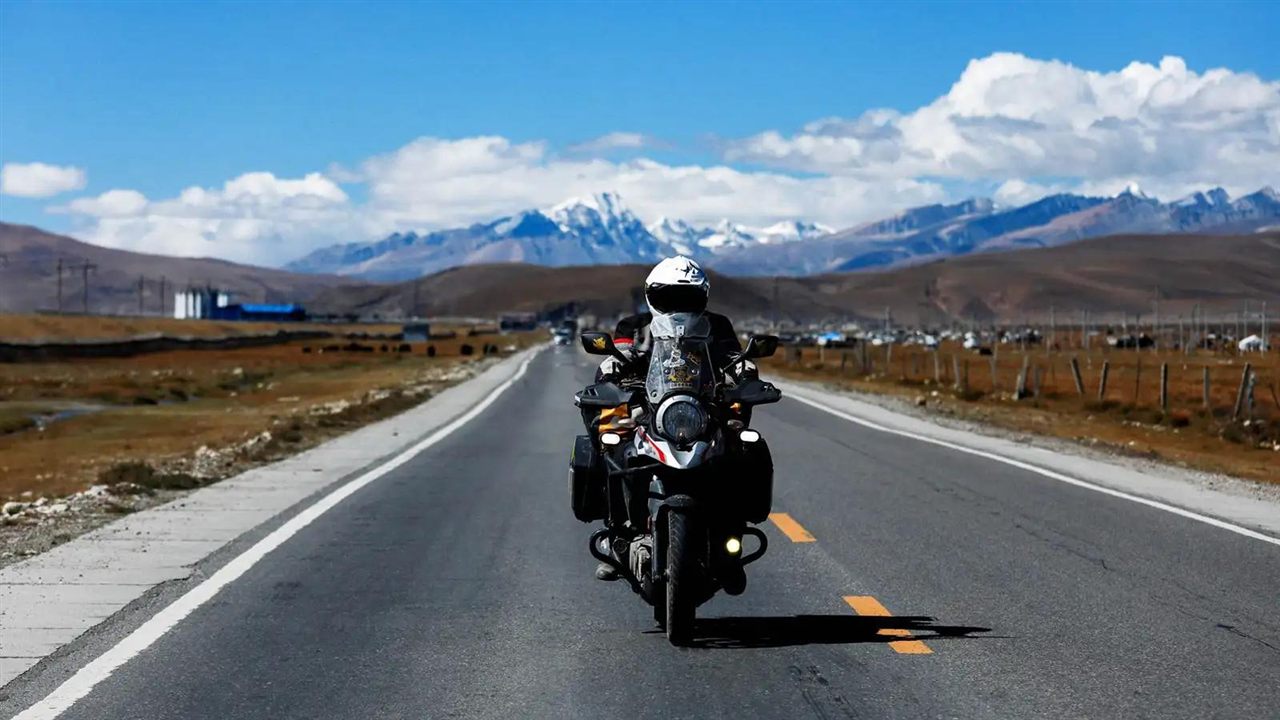
Your motorcycle customs declaration China paperwork will cover most of the basics, but the Pamir Plateau’s thin air, long straight roads, and scattered checkpoints don’t forgive sloppy planning. Get your docs in early, get your route filed correctly, stick to the open roads, and you’ll get those high-altitude views without being turned around at the first checkpoint.