Last updated: November 4, 2026
"best motorcycle routes China" and "中国摩旅路线" are the questions foreign riders search most after bringing their bike into China. First time riding in China - which route? The Duku Highway in Xinjiang, G318 in Tibet, the Yunnan-Tibet line - each has its own scenery and difficulty. This guide focuses on the routes I have ridden and taken customers on: distance, season, difficulty for each, plus the restricted areas foreign riders must know. Restricted areas first, then routes - that is the first piece of advice I give every customer.
Restricted areas first, then the routes
Foreign riders can go almost everywhere in China on a motorcycle, but a few routes are clearly closed:
- The G219 Xinjiang-Tibet line at Dahongliutan is closed to foreigners
- The Yecheng to Ritu (Pangong Tso) section is closed to foreigners
- The new uninhabited-area national highway in the Minfeng direction cannot be ridden
- Foreigners going from Xinjiang to Tibet must detour back via Golmud on the Qinghai-Tibet line G109
Keep these in mind and plan around them. Beyond that: Tibet requires a full-time guide, an itinerary filed in advance and a Tibet Travel Permit; Beijing requires a vehicle entry permit for foreign plates; and parts of the border-restricted zones in Xinjiang and Gansu cannot be entered. These are not scare stories - they are part of the route filing made at the border, and riding outside the filed route, if caught, can drag your deposit refund into trouble.
The Xinjiang loop: Duku Highway, Ili, Kashgar
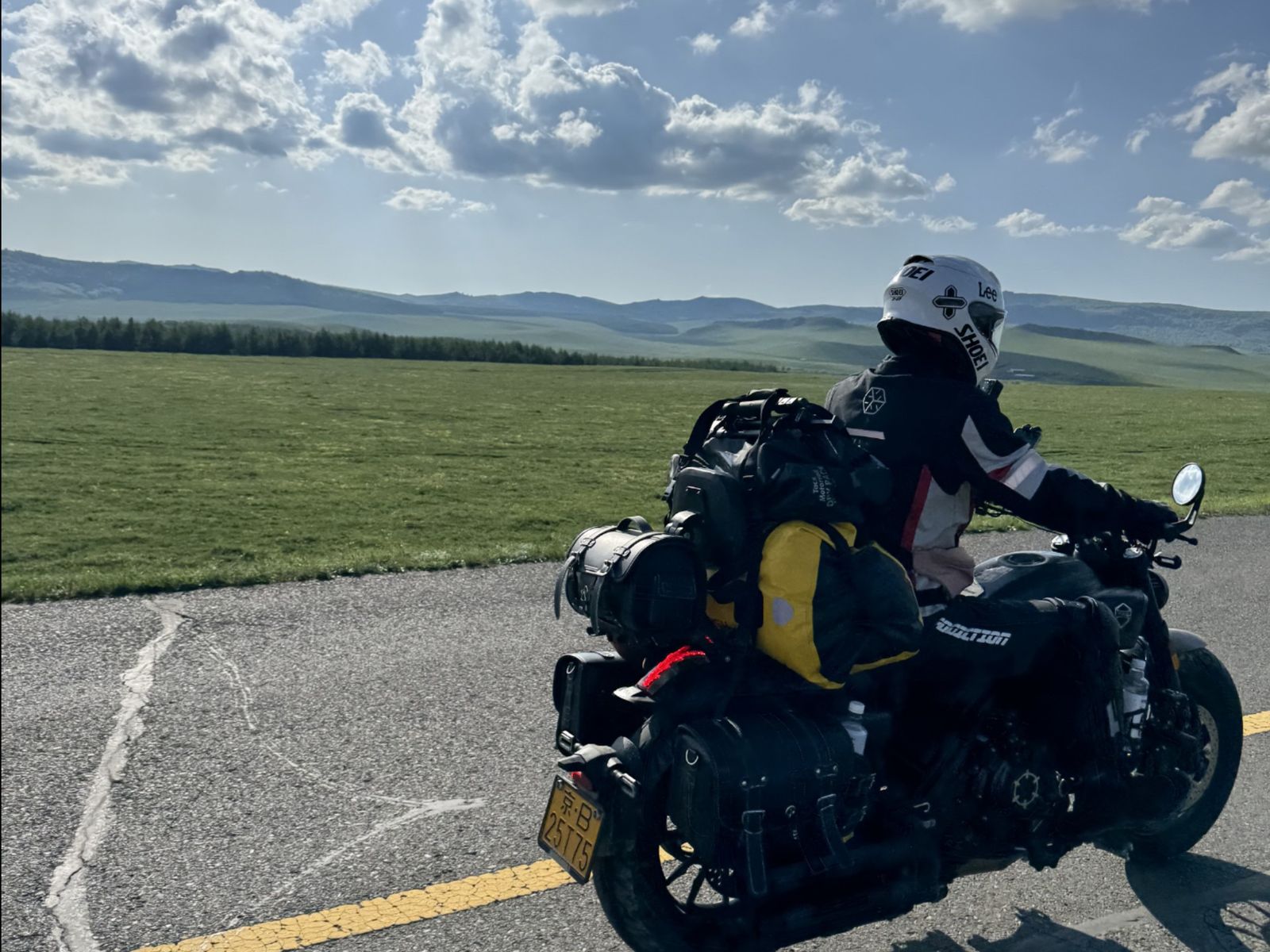
The Duku Highway is a section of G217, 561 km from Dushanzi to Kuqa across the Tianshan - in one day you can see grassland, gorges and snow mountains. It is open only from June to October; the rest of the year it is closed. Give it 2-3 days and do not rush: there are herders and sheep in the mountains, and overtaking needs patience. Altitude is moderate - just over 3,000 m at the top - but curves are many and grades steep, so bike control matters and beginners should not chase the limit. A good rhythm: day one Dushanzi to Qiaoerma, grassland and snow peaks, stay in Qiaoerma; day two Qiaoerma to Bayanbulak through the grassland; day three Bayanbulak to Kuqa, over the Tielimaiti pass and down through the canyon. Three unhurried days and you see the whole thing. Plan fuel ahead: Qiaoerma, Bayanbulak and Kuqa have stations, but the middle stretch does not - fill up before you leave.
The Ili direction: Sayram Lake, the Nalati grassland and the Guozigou Bridge are best in June-August when the grass is green and flowers are out. A lap of Sayram Lake is about 60 km; it is windy by the lake, so dress warmly. Nalati has entry tickets and shuttle buses, and whether you can ride the bike in is asked on site - usually you park at the lot.
Kashgar sits in Xinjiang's southwest corner; the old city and the desert highway along the edge of the Taklamakan are a different flavour. On the desert highway watch fuel and supply spacing - stations can be over a hundred kilometres apart, so fill up before you set out. The old city is worth a couple of rest days on a tour: baked buns, pilaf, meat in jars. Before heading toward Kashgar, confirm the scope of your filed route with your agent - some border counties in Xinjiang have restrictions, so stay on the filed route.
Notes for Xinjiang: distances between stations are long, especially between north and south Xinjiang - fill up before entering uninhabited stretches; some border counties require a border-area pass, and for foreign riders the filed route arranged by us is the reference - do not wander into restricted zones. Xinjiang is huge - one county to the next can be hundreds of kilometres - so plan each day's distance more conservatively than inland.
The Tibet lines: G318 Sichuan-Tibet and G109 Qinghai-Tibet
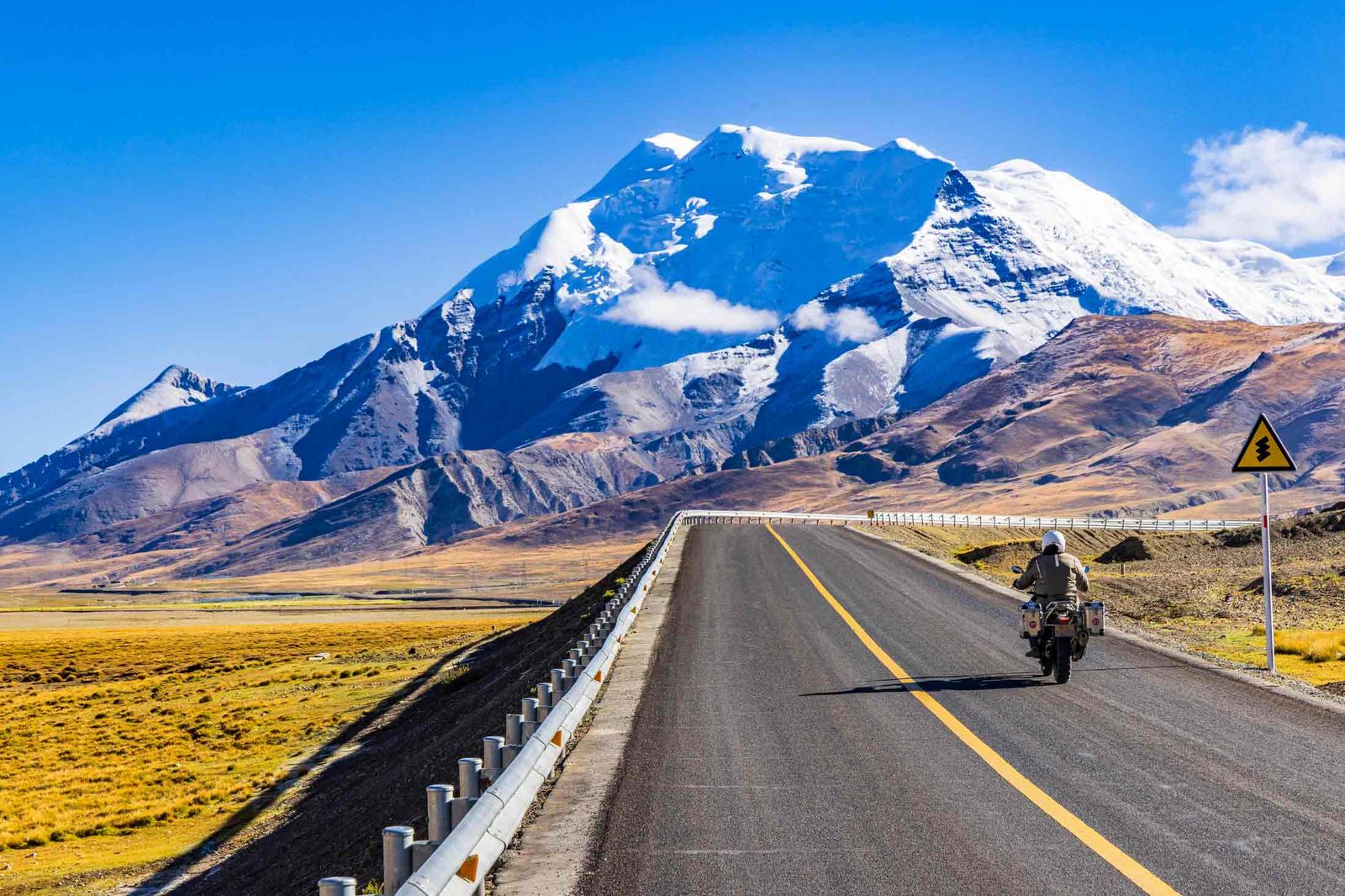
G318, the Sichuan-Tibet line, is the famous one: Chengdu to Lhasa about 2,140 km, crossing passes like Zheduo, Dongda and Selijila at 4,000-5,000 m, with scenery changing from canyon to grassland to snow mountains. Give it 8-10 days and do not charge hundreds of kilometres in a day - altitude sickness is no joke. It is rideable May-October; July-August is the rainy season, so watch landslide and mudslide forecasts and ease off when rain is continuous.
The difficulty of the Sichuan-Tibet line is altitude and weather: storms arrive at the passes without warning, and sun and rain alternate within a single day. On a bike, warm and waterproof gear must be right, and gloves must be waterproof, or your hands will freeze on the way down a pass. On fuel: stations are denser than you might expect, but fill up every morning and do not gamble that the next station will have fuel.
G109, the Qinghai-Tibet line, runs Xining to Lhasa, about 1,950 km, at a higher overall altitude - straight roads, good visibility, but heavy truck traffic, so pick your overtaking moments. It is rideable in winter but cold; May-October is better. Its character: high altitude but gentle grades, so it is not physically hard - the catch is sitting above 4,000 m all day, which tires you out; keeping each day under 300 km is a steady pace.
Foreigners coming from Xinjiang into Tibet can only use the Golmud detour on G109 - that is the rule, not a suggestion. Do not think of taking the Xinjiang-Tibet line as a shortcut.
The Yunnan line: Shangri-La and the G214 Yunnan-Tibet route
G214, the Yunnan-Tibet line, Dali to Mangkam about 500 km, is the alternative many people use to enter Tibet, and it can also be ridden on its own. The Dali-Lijiang-Shangri-La-Deqin stretch has better surfaces than the Sichuan-Tibet line, with snow mountains, canyons and Tibetan villages rotating past; May-October all work, and late April-May or late September-October are the most stable weather.
The Yunnan line suits riders just after entry especially well: come in at Mohan, spend two days adapting on Dali-Lijiang, then decide whether to continue toward Tibet. Shangri-La sits above 3,000 m, a useful place to test your altitude response. The Dali-Lijiang stretch has good roads and scenery and mature guesthouses and restaurants - the right first long run after entry.
The Inner Mongolia grassland route deserves a line too: the prairie highways based out of Hohhot or Xilinhot, best in June-September when the grass is green - big sky, big land, straight roads, little traffic, made for relaxed riding. Supply points are sparse on the grassland; towns can be dozens or a hundred-plus kilometres apart with no station in between, so fill before entering the grassland and carry water and snacks. Wind is strong, crosswinds are common - watch them at speed and do not run at max.
What to watch when touring China by motorcycle
- Fuel: stations are dense in cities and along national highways, but in parts of Tibet and Xinjiang the gaps are long - fill up before entering remote or mountainous stretches and plan your next stop. China does not allow carrying loose fuel, so do not plan on a jerrycan.
- Altitude: do not push hard on the plateau; keep day one short and give your body time. Serious altitude sickness is not trivial - do not tough it out; dropping to lower elevation to rest is the proper fix.
- Season: March-May spring flowers suit southern routes; June-August is the good season for Tibet and Xinjiang but also the crowds; September-October has the best colours and stable weather; in winter most high passes in Xinjiang and Tibet are ice- and snow-bound, so head south.
- Temporary plate and licence: the temporary plate is valid for 3 months, the temporary licence is arranged by us, and China does not recognise international driving permits - do not kid yourself on this one. Vehicle entry and the temporary licence are declared by a licensed travel agency, and right-hand-drive bikes are accepted like left-hand-drive at no surcharge.
- If you are stopped: at a checkpoint or by traffic police we assist remotely with proof; just ride the filed route.
Combining routes: string lines together if you have time
Many riders ride more than one line. Last month an Australian rider on a Triumph Tiger 900 came in at Mohan with 18 days and wanted snow mountains, grassland and lakes. The plan I laid out: in at Mohan, 2 days in Kunming to adapt, Dali-Lijiang-Tiger Leaping Gorge-Shangri-La on G214 to Deqin in 5 days, fly back to Chengdu for the western Sichuan mini-loop in 4 days, and exit from Chengdu. Cross-line combinations are common - understand the single lines first, then talk combinations. The western Sichuan mini-loop starts and ends in Chengdu, about 900 km, 4-5 days, linking Siguniang Mountain, Danba's Tibetan villages, Gongga and Yala snow mountain; April-June and September-November both work, and it is many riders' first taste of the plateau.
Quick season reference
Run through the year and you will know where to go when:
- March-May: spring flowers - Yunnan, Guangxi, Fujian and Hainan all suit. The Yunnan-Tibet line and western Sichuan start warming, snow not fully gone but rideable.
- June-August: Xinjiang and Tibet enter their good season; the Duku Highway opens in June, Qinghai Lake's rapeseed is at its peak in July. The downside is peak crowds - book lodging ahead.
- September-October: the steadiest window of the year - rainy season just past, autumn colours at their best; western Sichuan, the Yunnan-Tibet line and the Inner Mongolia grassland all suit. The Duku Highway is still rideable before it closes in October.
- November-February: head south - Yunnan, Guangxi and Hainan for the winter. Most high passes in Xinjiang and Tibet are ice- and snow-bound; do not go.
Riding gear and preparation
Route decided, do not skimp on gear. These are the basics for touring China by motorcycle:
- Protection set: helmet, knee and elbow guards, riding boots. China has a mature riding culture and plenty of riders on the road, and traffic police will also remind you if your gear is incomplete.
- Rain suit and dry bags: mountain and plateau weather turns on a coin; sun and rain alternating within a day is common. Waterproof gloves are a must - frozen hands coming off a pass is a moment when accidents happen.
- Warm layer: plateau temperature swings are big - over 20 degrees in the day and below zero at night possible - so a packable down or fleece layer takes no space and pays for itself.
- Phone data and offline maps: signals are weak on remote stretches; download offline navigation packs in advance and mark fuel and repair points.
- Cash and payment: mobile payment is universal in big cities, but cash is steadier in remote areas - carry some small notes.
- Bike tools: basic tools, puncture kit, chain oil - your lifeline where there is no repair shop.
With gear ready, build one more habit: check the weather and road notices every morning before departure - landslide warnings and roadworks on mountain stretches are worth checking before you go, far easier than rerouting on site. Long-distance riding is not a sprint; treat every day as its own itinerary and stay steady.
Common questions
Q: Which route suits a first-time rider in China?
A: The Yunnan line. In at Mohan, then Dali-Lijiang-Shangri-La - good roads, mature food and lodging, altitude rising step by step. Adapt to Chinese riding first, then go further.
Q: Can motorcycles ride on Chinese expressways?
A: Most provinces allow motorcycles on expressways, keeping to the rightmost lane and not going under the minimum speed. Some city sections and specific bridges and tunnels ban bikes - follow navigation prompts and signs and do not enter banned sections.
Q: Can a motorcycle enter Tibet?
A: Yes, but it needs a Tibet Travel Permit, a full-time guide, and an itinerary filed in advance, with documents submitted 1 month ahead. Parts of the G219 Xinjiang-Tibet line are closed to foreigners, and Xinjiang-to-Tibet must detour via Golmud on G109.
Q: When does the Duku Highway open?
A: June to October; closed the rest of the year. Even in the open season it can be temporarily controlled by weather, so check the road status on your day before setting out.
Q: Where can I ride in winter?
A: Head south - Yunnan, Guangxi, Hainan and Fujian stay mild. High-altitude stretches in Xinjiang and Tibet are ice-bound and closed; winter is not the time.
Q: What if fuel runs short on a long run?
A: Fill before departure and plan the next station. In remote areas stations can be over a hundred kilometres apart - always fill before mountains or uninhabited stretches. China does not allow carrying loose fuel, so no jerrycan plans.
Q: Does altitude affect the bike on a first plateau trip?
A: Thin air cuts power; carburetted bikes need the mixture adjusted, while fuel-injected bikes are mostly fine. The rider needs adaptation more than the bike - no hard running on day one, climb altitude slowly, and stop to rest when something feels off.
Q: How many days for the Inner Mongolia grassland?
A: Depends how far you go. Hohhot to Xilinhot is about 600 km, 2-3 days; push east to Arxan and it grows to 4-5. The grassland has long straight stretches that tempt you to speed - keep the pace controlled and mind the crosswinds.
These routes I have all ridden, and I can tell you the season and difficulty of each one. Tell me your time window and the scenery you want, and I will arrange the routes, restricted areas and filing in one pass. Start by adding WeChat qxzj7557 for a chat; WhatsApp, same number: +86 13759155671. Email: [email protected]. Yunnan Province International Travel Service (Group) Co., Ltd. - full outbound qualifications, with the 1.6 million RMB quality guarantee deposit lodged with the tourism authority.
On a related note, I have also written about quiet here.
Ready to plan your ride into China?
Customs declaration, temporary plate, temporary licence and guarantee - handled for you end to end. Ride across the border on arrival day and keep your energy for the road.
WeChat / WhatsApp: +86 13759155671 · Email: [email protected]
Contact Us Now