Last updated: November 3, 2026
At a Glance
"China motorcycle touring routes" is what foreign riders search once their bike is in at Mohan or Khorgos — which line for a first visit? Sichuan West, Yunnan–Tibet G214, Xinjiang’s Duku Highway, the Qinghai Lake loop and Inner Mongolia grassland roads all differ in difficulty, scenery, season and restricted zones. This guide lays out five classic lines I have ridden and guided clients on, with distance, days, difficulty, season and foreign-rider notes for each — pick by your own time window.
Why These Five
More riders are touring China every year, and the common question is: first time in China on a motorcycle, which line? My answer is never "one line" — first look at your time and fitness, then choose among five classic routes. These five I have ridden and guided: Sichuan West loop, Yunnan–Tibet G214, Xinjiang’s Duku Highway, Qinghai Lake loop and Inner Mongolia grassland roads. Difficulty, scenery, season and cautions for each, one by one.
Last month an Australian rider brought a Triumph Tiger 900 in through Mohan with only 18 days, and asked: "I want snow mountains, grassland and lakes in one trip — how do I arrange it?" I laid out: Mohan in, 2 days acclimatising in Kunming, Dali—Lijiang—Tiger Leaping Gorge—Shangri-La on G214 to Deqin in 5 days, fly back to Chengdu for the Sichuan West loop in 4 days, then exit from Chengdu. Cross-line combinations like this are common — get the single lines clear first, then combine.
Overview table first:
| Route | Distance | Suggested Days | Difficulty | Season |
|---|---|---|---|---|
| Sichuan West loop | ~900 km (from Chengdu) | 4–5 | Moderate | Apr–Jun, Sep–Nov |
| Yunnan–Tibet G214 | ~500 km Dali to Markam | 3–5 (continue on G318 to Tibet) | Medium-high | May–Oct; late Apr–May and late Sep–Oct better |
| Duku Highway | 561 km | 2–3 | Medium-high | Open only Jun–Oct |
| Qinghai Lake loop | ~360 km | 1–2 | Low | Jul–Aug |
| Inner Mongolia grassland | As you like | 3–7 | Low–medium | Jun–Sep |
Route 1: Sichuan West Loop — Dense Scenery, the First Plateau Intro
The Sichuan West loop starts and ends in Chengdu, roughly 900 km, 4–5 days. It links Siguniang Mountain, Danba Tibetan villages, Gongga and Yala snow mountains — snow peaks, gorges, Tibetan villages and meadows in rotation. Scenery density is high, which is why it is the first plateau choice for many.
Difficulty is moderate: altitude runs from a few hundred metres to over 4,000 m with mountain passes, but nothing extreme. The key is altitude sickness — do not schedule day one too full; give the body 2–3 days to adapt and do not push hard early. In the rainy season (mid-June to August) some sections have landslide risk — check the forecast before setting out and hold off during sustained rain. A bowl of changfen noodles in Chengdu is 12 RMB, a good meal before heading up; a hotel in Kangding 200–300, a Tibetan guesthouse in Xinduqiao 150–250.
Season: April–June, spring snow lingering and grassland greening; late September to late October is the widely accepted golden window — rainy season over, weather stable, autumn colours at their richest, snow mountains most visible. In winter high passes have ice; not recommended for first-time riders.
Foreign riders: Sichuan West is regular open territory — ride your filed route as normal.
Route 2: Yunnan–Tibet G214 — the Classic Northern Line into Tibet
G214 is the classic Yunnan route into Tibet: Dali—Lijiang—Shangri-La—Deqin (Meili Snow Mountain)—Yanjing—Markam, about 500 km from Dali to Markam, where you can continue on G318 toward Lhasa. The headline is Meili Snow Mountain — with luck you catch the golden dawn light — plus gorges, salt fields and Tibetan towns all along. A view room at Feilaisi in high season runs 400–600 a night; the window opens onto the Meili thirteen peaks, and the few minutes of dawn light after 7 am are worth the wait.
Difficulty is medium-high: altitude climbs fast — Shangri-La is already around 3,300 m, Markam higher — with many passes. Prepare both fitness and altitude tolerance.
Season: May–October. Late April–May and late September–October are the more comfortable windows: less rain, clear snow peaks, good temperatures. June–August is the rainy season; northwest Yunnan and southeast Tibet see heavy rain with higher landslide risk — watch the weather on this stretch.
Foreign riders: the G214 direction into Tibet means a Tibet itinerary — Tibet requires a guide for the whole trip, a filed itinerary and a Tibet Travel Permit, with documents one month ahead. If you ride only to Deqin and the Meili area without crossing into Tibet, that is Yunnan proper — ride as normal.
Route 3: Duku Highway — 561 km Along the Tianshan Spine
The Duku Highway is a section of G217, running from Dushanzi in the north to Kuqa in the south, 561 km across the Tianshan. One road packs desert, canyons, grassland, passes, lakes and grottoes — four seasons in a day. A guesthouse in Nalati town runs 200–350; a hotel in Bayanbulak town 300–500; book ahead in high season.
Difficulty is medium-high: tight bends and big elevation changes, over half the road threading through steep mountains. The surface is good — sealed, ride to the limit signs and you are fine.
The critical fact: because of snow and ice in the mountains, the Duku Highway is open only from June to October each year; it is closed the rest of the time. It reopens around June 1 and winter-closes around mid-October. Want to ride Duku? The window is these months; come outside it and you ride nothing. A pitfall story: last year a European rider flew to Urumqi in late September, but the cold front came early, Duku closed a week ahead of schedule, he waited in Kuytun for 3 days and finally detoured to Ili on the Lianhuo expressway.
Sights along the way: Dushanzi Grand Canyon, Nalati grassland, Bayanbulak Swan Lake, Tianshan Mysterious Grand Canyon. Two to three days is comfortable; a rushed rider can cross in a day, but everyone who has ridden it says: do not rush, this road deserves slow.
Foreign riders: some Xinjiang border restricted zones are closed. Duku itself is a regular open section — ride your filed route; but do not extend toward the Xinjiang–Tibet line — the G219 Dahongliutan section and the Kashgar–Yecheng to Rutog (Pangong Tso) section are not open to foreigners, and the newly built unmanned-area national road in the Minfeng direction is also closed. From Xinjiang to Tibet you must loop back through Golmud on the Qinghai–Tibet Highway G109. Keep these zones out of your plan.
Route 4: Qinghai Lake Loop — Low Difficulty, High Reward
The Qinghai Lake loop is about 360 km — a full lap in 1–2 days. Good road, altitude around 3,200 m but with gentle variation; difficulty is low, suitable for warming up on a first plateau trip or relaxing after a long line. In the July canola season, lakeside guesthouses run 200–400 a night and a Qinghai clay-pot hotpot for two is 120–180.
Season: July–August, when the lakeside canola fields are in bloom — blue water against gold flowers at the prettiest time of year, with comfortable daytime riding. Other seasons the lake is still there, but the flowers are gone and temperatures drop a lot.
Ride the loop clockwise or counter-clockwise, either works; supply points are plentiful and fuel stations adequate. Qinghai Lake sits along the northwest loop and the G109 Qinghai–Tibet line, easy from Xining — G109 is also the required detour for foreign riders going from Xinjiang to Tibet, so the lake loop can tag along naturally.
Route 5: Inner Mongolia Grassland — Long Straights and Open Sky
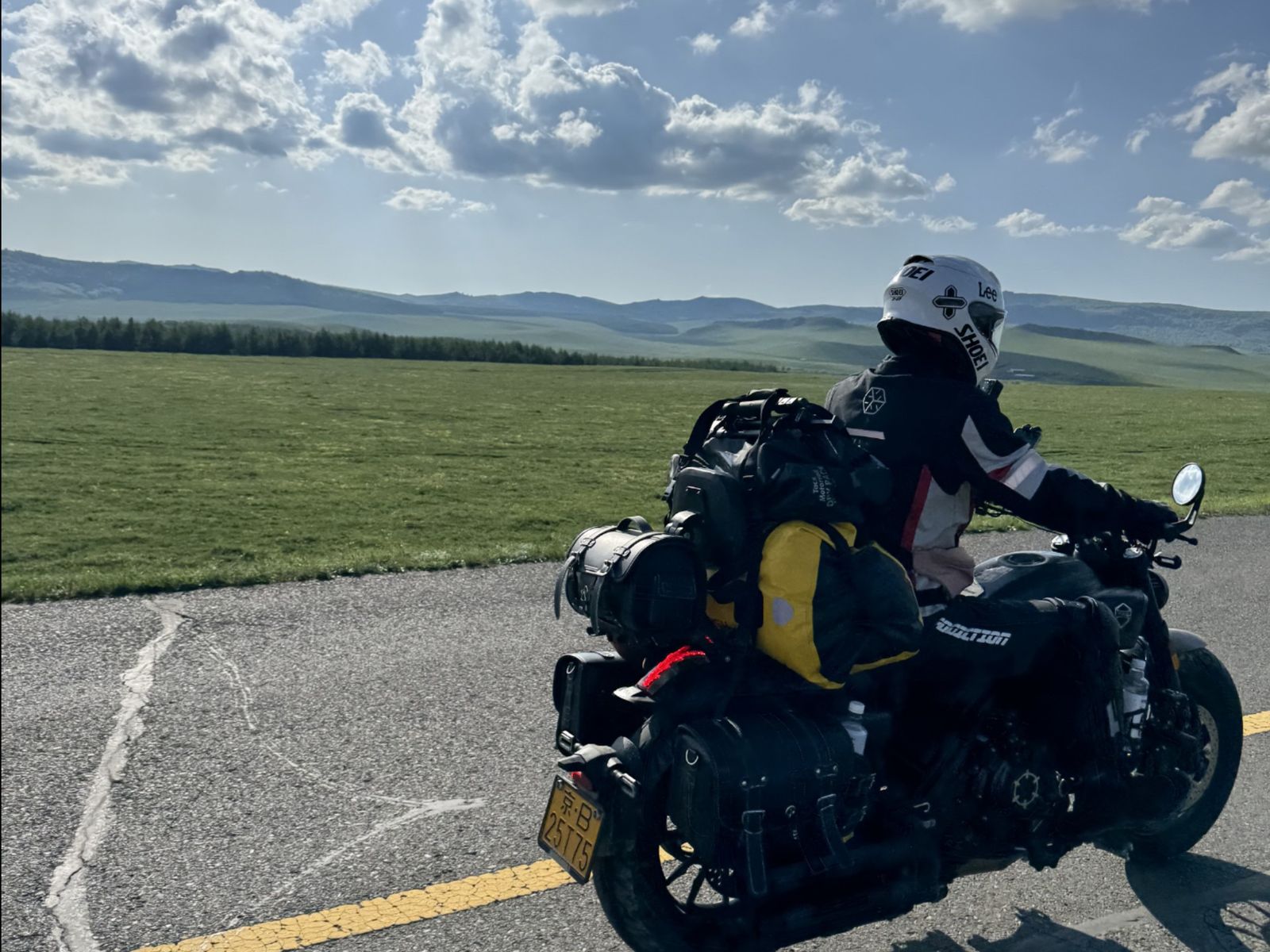
Inner Mongolia grassland roads are a different experience: endless grassland, straight roads, low clouds. Both the Hulunbuir and Xilingol regions are rideable; the route is as long or short as you like, 3–7 days. A yurt stay in July runs 300–500 a night; roast lamb chops around 150.
Difficulty is low to medium: good surface, open views — but watch two things. Crosswind: grassland winds are strong, especially with loaded bikes — hold the bars steady. Long straights cause fatigue: stop once an hour, do not push through.
Season: June–September, the golden period from grass greening to early autumn. July–August is greenest, September turns gold — each its own look. Do not come in winter: minus 20 to minus 30 degrees is not riding season.
Foreign riders: Erenhot port is right in this region — riders from the Mongolia direction can enter at Erenhot (service fee RMB 8,500 per vehicle) and ride the grassland line on the way. On restricted zones: Inner Mongolia regular areas ride normally; follow your filed route.
How to Choose — by Time
Only 3–4 days: Sichuan West loop or the Qinghai Lake loop — one an intro, one a relaxing lap; both show representative Chinese scenery in a short window.
One week: G214 as far as Dali—Shangri-La—Deqin, or 2–3 days on the Duku Highway with rest days around it.
Two weeks or more: combine — warm up on the Qinghai Lake loop, head toward Tibet on G109 or G214, or do Duku properly in Xinjiang and consider the Inner Mongolia grassland line.
My Experience: Three Things After Many Trips
First, on a first China visit, warm up on a low-difficulty line — do not jump straight onto Duku or G214. Let the body adapt to altitude and right-side riding before raising the difficulty; the safety margin is completely different.
Second, lock the season when planning: Duku’s window is June–October; G214 avoids the June–August rainy core; Sichuan West’s golden period is late September–late October. Routes and seasons must be planned together — do not pick a route and ignore the calendar.
Third, foreign riders, memorise the restricted zones: Tibet needs a permit and full-time guide with documents a month ahead; Beijing needs an entry permit; parts of Xinjiang and Gansu border zones are closed; the G219 Dahongliutan section and Yecheng–Pangong Tso section are not open; Xinjiang to Tibet goes via Golmud on G109. What your filed route covers is what you may legally ride — keep these red lines in the plan.
Quick Q&A
Q: Which route for a first China motorcycle trip?
A: The Sichuan West loop or the Qinghai Lake loop — low difficulty, dense scenery, good for the adaptation phase.
Q: When is the Duku Highway open?
A: Every year June–October; closed the rest of the year.
Q: When is the best time for G214?
A: May–October works; late April–May and late September–October are better; be cautious in the June–August rains.
Q: Can foreign riders ride the Duku Highway?
A: Duku is a regular open section — ride your filed route; but the G219 Dahongliutan and Yecheng–Pangong Tso sections are not open, and Xinjiang to Tibet must go via Golmud on G109.
Q: How do I plan a grassland ride from Erenhot?
A: Erenhot service fee is RMB 8,500 per vehicle; after entry ride toward Xilingol or Hulunbuir — best June–September.
Five lines cover entry to advanced: Sichuan West for snow peaks and gorges, G214 for Meili Snow Mountain, Duku for four seasons in the Tianshan, Qinghai Lake for lake and flowers, grassland for open sky. Match the time first, then pick the line, keep season and restricted zones in mind — and the road of Chinese motorcycle touring is open in front of you.
For help or a quote, contact us: Yunnan Province International Travel Agency (Group) Co., Ltd. Phone / WhatsApp: +86 13759155671; WeChat ID: qxzj7557; Email: [email protected]. I’m Zara — tell me your time window, bike model and entry port, and I will lay out how to combine the five lines.
On a related note, I have also written about terrain here.
Planning to ride your motorcycle into China?
We handle the entire entry process — customs, plate, permit, guarantee. You ride across on entry day and focus on the road.
WhatsApp / WeChat: +86 13759155671 · Email: [email protected]
Contact Us Now →