Last updated: November 17, 2026
Motorcycle Entry into China: Why Vintage Bikes Need Extra Prep
I stood in a monsoon downpour at the Mohan border last April, my 1978 British right-hand-drive vintage Triumph spattered with Laos road grime, watching a rider on a modern sport bike clear foreign motorcycle temporary entry China checks in 40 minutes while I waited three hours. The customs officer tapped my bike’s hand-stamped engine plate and raised an eyebrow. “Custom build?” he said through the agency’s on-site translator. “Need more papers.”
That day taught me motorcycle entry into China for vintage or custom bikes isn’t harder, exactly — it just demands more forward planning. I’ve ridden six China motorcycle road trip routes since 2019, on everything from a stock 2019 BMW to a hand-built café racer I assembled in my garage in Yorkshire. This guide pulls every lesson I’ve learned the hard way.
First Rule: You Can’t Clear Customs Alone
I made this mistake on my first trip, back in 2018, when I turned up at Erenhot with a folder full of papers and a belief that I could sort motorcycle customs declaration China myself. The border guard just shook his head and pointed to a row of agency offices down the road.
Foreign vehicles must be declared through a qualified travel agency acting as guarantor — individuals have no standing to declare and cannot clear customs on their own. Qualified agencies hold a RMB 1.6 million tourism quality deposit and have at least three years of operation. I’d rather pay the service fee than waste two days at a port arguing with officials, trust me.
Choosing Your Entry Port: Which Works for Your Route?
There are four land ports and three sea ports that handle foreign motorcycle temporary entry China. I’ve used Mohan twice, Khorgos once, and shipped a bike through Dalian once. All ports accept both left- and right-hand-drive vehicles, with the same fees and no surcharge — I was relieved about that, as my old Triumph is right-hand drive and I’d heard rumours of extra charges that turned out to be nonsense.
Land Ports: My Personal Picks
Mohan (磨憨) on the China-Laos border is my go-to for rides starting in Southeast Asia. I’ve done Mohan border motorcycle customs clearance three times now, and the process is smoother than most northern ports for bikes, as the staff handle a lot of two-wheeled traffic. Service fees for Mohan entry run 5,000-6,000 RMB per vehicle; if your bike is registered in Laos, it’s 4,000 RMB.
Khorgos (霍尔果斯) on the China-Kazakhstan border works for Central Asian routes, with fees of 6,000-9,000 RMB. If you’re crossing the whole country — say, entering at Khorgos and exiting at Mohan, or the reverse — there’s an 8,000 RMB full cross-through package. I did that route in 2021, riding down through Gansu to Yunnan, and it worked out cheaper than booking two separate entries.
Erenhot (二连浩特) on the China-Mongolia border costs 8,500 RMB for entry. Gyirong (吉隆) on the China-Nepal border is another option, though I haven’t used it myself.
Sea Ports: For Long-Haul Riders
If you’re shipping your bike from further afield, the sea ports are Dalian, Guangzhou and Shenzhen. I shipped my custom café racer through Dalian in 2022 — the entry fee was 18,000 RMB, not including ocean freight. Guangzhou entry is 22,000 RMB, also excluding freight.
All service fees cover customs declaration, immigration formalities, temporary driving licence, temporary plate, exit clearance, route filing and on-site port assistance. They don’t cover customs deposit, vehicle insurance, document translation, vehicle inspection (about 200 RMB), or on-road costs like fuel, tolls, food and accommodation.
One thing I didn’t expect: the fee is the same whether you stay one month or three months. It’s not charged per day, so you don’t have to rush your trip if you want to linger in Yunnan or Sichuan.
Paperwork: What You Need for Vintage & Custom Bikes
For my custom build, I nearly messed up the engine number documentation. I’d engraved it myself when I rebuilt the engine, and the customs team wanted extra proof it matched the registration. Get all your papers in order 20 days ahead of entry — if you’re heading to Tibet, make that 1 month ahead.
You’ll need:
- Passport, Chinese visa, driving licence, and a white-background ID photo
- Vehicle licence, registration certificate, engine number, and one photo each of the front, rear and side of your bike
- An inspection certificate if your vehicle is over 6 years old — this is non-negotiable for vintage bikes, and I’ve seen riders turned away for missing it
Documents other than a Chinese licence need Chinese translation, which the agency arranges. I tried to get my own translation done in the UK once, and it was rejected because it didn’t have the right official stamp. Save yourself the hassle and let the agency handle it.
Vehicles over 6 years old also have to pass an inspection at the vehicle management office after entry; some ports also require a valid home-country annual inspection certificate. My 1978 Triumph passed its inspection in Kunming no problem, but I did have to adjust the headlight beam for right-hand traffic first.
Customs Deposit: The Nitty Gritty
With the agency’s guarantee, the customs deposit you pay is only 10,000 RMB. It has to be paid into the company’s corporate account — never a personal account — and must arrive 3 days before entry. If it’s late, your declaration is cancelled and the service fee isn’t refunded. I once had a bank delay on a transfer and had to beg the agency to push my entry date back by a week; they could do it, but it was a stressful 48 hours.
The deposit is fully refunded by the same route within 3-5 working days after exit, as long as you exit on time without overstaying, have no outstanding traffic fines, and no unpaid fees or unfinished customs matters. I’ve had my deposit refunded four times now, and it’s always hit my account within the 3-5 day window.
Licences, Plates and Insurance: What You Actually Get
China is not party to the UN road convention and does not recognise the International Driving Permit. You need a China temporary driving licence, which the agency arranges. I see a lot of new riders asking about IDPs online — save your money, they won’t work here.
The motorcycle temporary plate China issues for foreign bikes is valid for 3 months. That’s plenty of time for most cross-country rides, in my experience.
Compulsory traffic insurance is mandatory — without it, a temporary plate can’t be issued. The agency purchases it before entry, and you pay the actual cost. Commercial third-party cover from 500,000 RMB is optional, but I always take it. Riding on unfamiliar roads with different traffic norms? I’d rather have the extra cover.
Vehicle inspection costs about 200 RMB, which you pay separately. For vintage bikes, the inspector will check your brakes, lights and engine number, so make sure everything is in working order before you arrive.
Where You Can Ride (and Where You Can’t)
One of the best things about a China motorcycle road trip is that you can ride almost nationwide, but there are a few restrictions to know about.
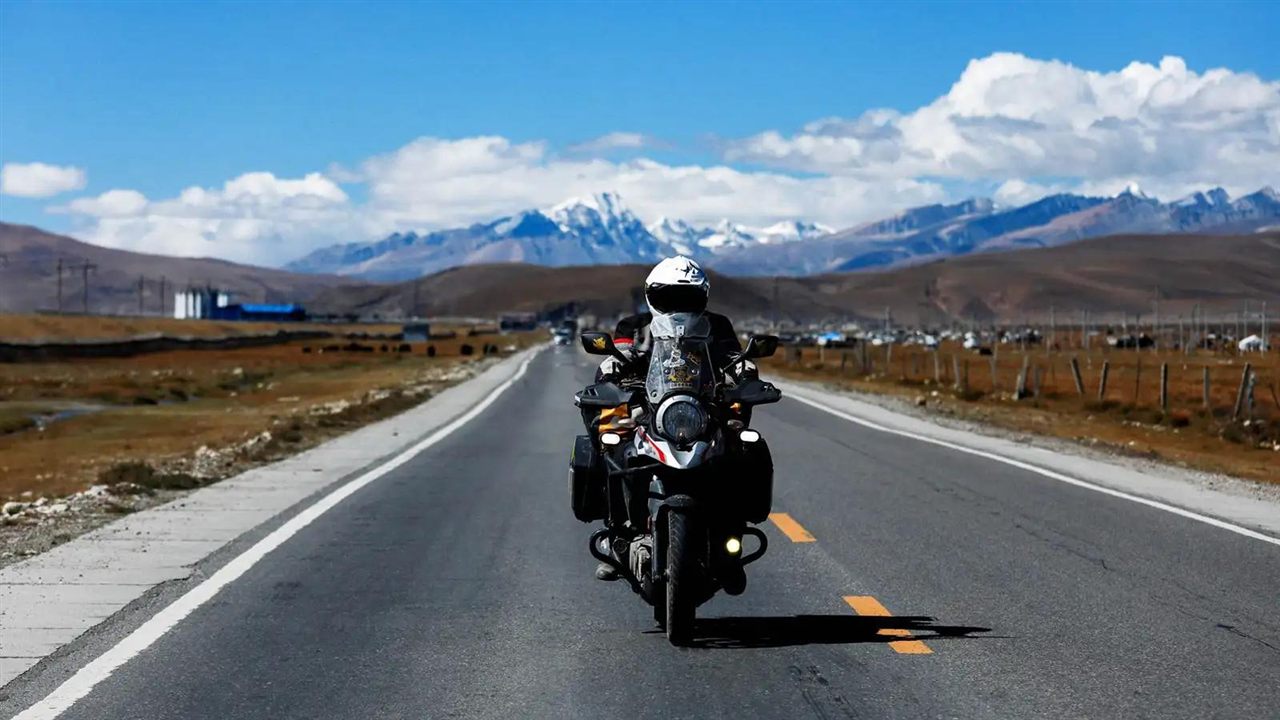
Tibet requires a full-time guide and a Tibet permit — there’s no way around that. I rode the G318 into Lhasa in 2020, and my guide was a local rider who knew all the best roadside noodle stops. The legal highways into Tibet are G109, G318 and G214.
Beijing requires a capital entry permit. Some border-restricted areas in Xinjiang and Gansu are off limits, and the G219 at the Dahongliutan section, plus the Kashgar/Yecheng to Ritu (Pangong Lake) section, are closed to foreigners. The new Minfeng no-man’s-land highway is also closed to foreigners. If you’re travelling from Xinjiang to Tibet, you have to detour via Golmud on G109.
China drives on the right, so if you’re on a right-hand-drive bike, give yourself a day or two to adapt. I still find myself reaching for the gear lever on the wrong side after a week on Chinese roads. Ports aren’t open 24 hours, so plan your arrival for daytime. At checkpoints or police stops, the agency provides supporting documents remotely — I’ve had to call them once at a checkpoint in Qinghai, and they sent the paperwork over in 10 minutes.
You have to stick to your filed route, but you don’t need an escort or lead vehicle — except for the mandatory Tibet guide. I prefer riding on my own schedule, so that’s a big plus for me.
Visa Notes
China offers 30-day visa-free entry. If you want to stay longer, the agency can issue an invitation letter to help you get a longer tourist visa. I used this for my 2021 cross-country trip, as I wanted 10 weeks to ride from Khorgos to Mohan and take my time through Sichuan.
My best tip for vintage and custom bike riders? Pack a small folder with printed copies of every document, plus photos of your bike from every angle stored on your phone. When I had that delay at Mohan, having clear photos of the engine number and custom frame saved me another day of waiting. Ride safe, and don’t skip the Yunnan roadside barbecue stands.