Last updated: November 17, 2026
Motorcycle Customs Declaration China: Aux Fuel Tanks and Remote Tour Prep
I was sweating through my riding jacket at 32 degrees at the 磨憨 (Mohan) border last April, my Thai-registered right-hand-drive dual sport loaded with jerry cans I’d stuffed full of spare fuel for Yunnan’s backroads. The customs officer tapped the rear rack and raised an eyebrow, and I suddenly realised I’d barely thought about how auxiliary fuel containers fit into motorcycle customs declaration China rules.
That’s the thing about planning a China motorcycle road trip. You fixate on mountain passes and empty highways, and almost miss the small, boring details that can derail the whole trip before you’ve even crossed the line.
First: You Can’t Clear Motorcycle Customs Alone
Let’s get this out the way fast. For foreign motorcycle temporary entry China, individuals have no standing to declare and cannot clear customs on their own. You have to go through a qualified travel agency that acts as your guarantor. I tried to research self-declaration routes back when I was organising my ride, and I wasted three evenings going in circles.
The agency qualification is no small thing either — they need a 1.6 million RMB tourism quality deposit and three years of operation. I only figured that out after I’d cross-referenced three different official notices and a stack of forum posts.
What does that mean for your aux fuel tanks? It means you don’t argue about them at the border. You list every single one, their capacity, and whether they’re mounted or removable, when you submit your documents 20 days ahead. The agency handles the route filing and the declaration details long before you reach the gate.
Mohan Border Motorcycle Clearance: My Aux Fuel Reality Check
Back to that sweltering 磨憨 afternoon. I’d brought two 10-litre plastic jerry cans and a 5-litre mounted tank, and I’d listed all three on my initial paperwork. I thought I was being thorough.
“You declared three auxiliary containers,” the officer said through the agency’s on-site liaison. “Show me they’re empty.”
I blinked. I’d filled them that morning in Luang Namtha, because I’d heard fuel stations can be sparse once you head north toward Xishuangbanna’s hill country. That was my mistake.
Declaring the containers is required. Turning up with them full of fuel at the border is not a good call. The liaison pulled me to one side, away from the queue of trucks kicking up dust, and explained the rules calmly. Auxiliary fuel containers are allowed for remote area tours, but they have to be properly listed on your declaration, and the fuel inside counts as part of your vehicle’s declared goods.
I ended up draining the two removable jerry cans into a spare container the agency kept on hand for exactly this sort of mess, and kept only the mounted tank half full. It added 40 minutes to my clearance, but it was a cheap lesson compared to having the bike held up.
What’s Included in the Entry Package
For Mohan entry, the fee runs 5,000-6,000 RMB per vehicle (Laos-registered bikes are 4,000 RMB). That price covers customs declaration, immigration formalities, your Temporary China Licence, motorcycle temporary plate China, exit clearance, route filing and on-site port assistance.
It does not cover the customs deposit, vehicle insurance, document translation, the roughly 200 RMB vehicle inspection, or any of your fuel, tolls, food or accommodation.
Here’s what I’d flag for anyone carrying extra fuel:
- List every auxiliary container, mounted or loose, in your initial document submission. Don’t wait until you get to the port.
- Keep removable containers empty at the border. You can fill them once you’re inside China at a regular fuel station.
- Stick to your filed route. If you’re heading into remote areas, make sure those roads are included in your initial route filing before you enter.
The customs deposit is 10,000 RMB, paid into a corporate account — never a personal one — and it has to arrive three days before entry. It’s fully refunded 3-5 working days after exit, as long as you leave on time, have no outstanding traffic fines, and no unfinished customs matters.
Plates, Licences and Where You Can Actually Ride
China does not recognise the International Driving Permit. You need a China temporary driving licence, and the agency arranges that for you as part of the package. The temporary plate is valid for three months, and the fee is the same whether you stay one month or three.
For a China motorcycle road trip focused on remote areas, you’ll also want to pay attention to restricted zones.
Tibet requires a full-time guide and a Tibet permit, and you’ll need to submit your documents a month ahead if Tibet is on your itinerary. The legal highways into Tibet are G109, G318 and G214. Some border-restricted areas in Xinjiang and Gansu are off limits, and the G219 Dahongliutan section, plus the Kashgar/Yecheng to Ritu (Pangong Lake) stretch, are closed to foreigners. The new Minfeng no-man’s-land highway is also closed to foreigners. If you’re going from Xinjiang to Tibet, you have to detour via Golmud on G109.
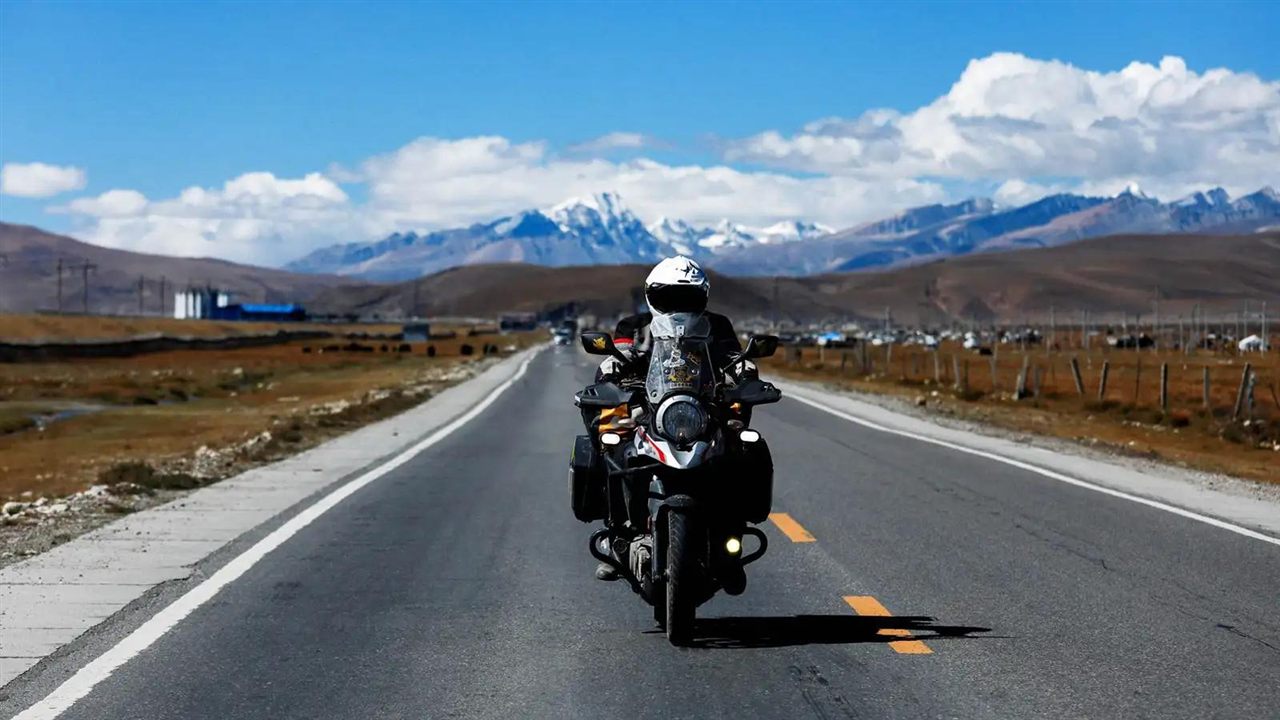
I didn’t go all the way to Tibet on that trip — I stuck to Yunnan and Sichuan, winding up through the Hengduan Mountains. Even there, I was glad I’d declared my aux tanks properly. I hit three small villages where the local fuel stations were closed for maintenance, and that 15 litres of spare fuel got me to the next town before dark.
Other Ports and Practical Notes
磨憨 is not the only land border you can use. The other three land ports are 霍尔果斯 (Khorgos, China-Kazakhstan), 吉隆 (Gyirong, China-Nepal) and 二连浩特 (Erenhot, China-Mongolia). There are also three sea ports: Dalian, Guangzhou and Shenzhen. Both left- and right-hand-drive vehicles are accepted at every port, for the same fees with no surcharge.
Khorgos entry runs 6,000-9,000 RMB, Erenhot entry is 8,500 RMB, and a cross-through package (Khorgos in / Mohan out, or the reverse) is 8,000 RMB full package. Sea entry via Guangzhou is 22,000 RMB (ocean freight not included), and Dalian sea entry is 18,000 RMB (ocean freight not included).
China drives on the right, so if you’re on a right-hand-drive bike, give yourself a day to adapt on quiet local roads before you hit the fast highways. Ports are not open 24 hours, so plan your arrival for normal working hours.
Compulsory traffic insurance is mandatory — without it you can’t get a temporary plate. Commercial third-party cover from 500,000 RMB is optional. The agency purchases insurance before entry and you pay the actual cost.
For bikes over six years old, you’ll need an inspection certificate, and you’ll also have to pass an inspection at the vehicle management office after entry. Some ports also require a valid home-country annual inspection certificate.
My Final Tip for Aux Fuel and Remote Rides
I rode 4,200 kilometres in two and a half months that trip, and I never had another issue with my auxiliary tanks. The key was that initial declaration — getting the details right early, so there were no surprises at the border.
Don’t treat auxiliary fuel containers as an afterthought. They’re part of your motorcycle, and they need to be part of your motorcycle customs declaration China paperwork from the start.
If you’re heading into areas where fuel stations are few and far between, plan your fills around the towns you know have stations first. Use your aux tanks as a safety net, not your primary supply. It’s easier, cheaper, and keeps you on the right side of the rules.